Multiscale.Sim Journal Articles Introduction
Material constant identification method of anisotropic elastic-plastic
- Published: May 2010
- Society / Journal Name:Presented paper of 15th Conference on the Japan Society for Computational Engineering and Science
Overview
A very large number of material constitutive laws to represent anisotropic elastic-plastic behavior have been proposed up to now. It is thought that there are roughly two immanent problems when assuming the application to a real problem.
- The selection criteria are unclear for which of the many constitutive laws is appropriate to choose.
- Supposedly even when the appropriate constitutive law is decided, you do not know the identification procedure of material property value s
These problems can be said to be the same as those for the anisotropic potential of the Hill which is implemented in the standard Ansys. This paper introduces the details of the identification procedure of material physical properties value and its application scope for the anisotropic potential of the Hill along with a number of cases.
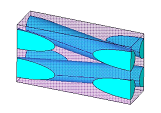
Figure 1. Analysis model description
Figure 1 shows one analysis example. CMAS is analyzed based on the homogenization method, and assumes that the analysis model continues on infinitely in all directions and are arranged periodically. Materials have been defined as fiber to elastic body, the matrix as elasto-plastic body
Figure 2 shows the comparison of the numerical material test results of a homogeneous one element model using the identified Hill constants and the model in Figure 1 that defines the composite material directly. It means that if the two graphs match, Hill constitutive law is able to correctly represent the actual ph enomena. You can see that the result of the Uniaxial test in xx direction is not able to reproduce accurately the actual behavior in the large strain region. Unlike the characteristics of the other 5 directions, presence of inflection point can be seen in the test result of the directly model in xx direction (red line). In this way, Hill constant has a tendency to degrade accuracy on the characteristics of directions that are not in a similar relationship to the characteristic of strain and stress.
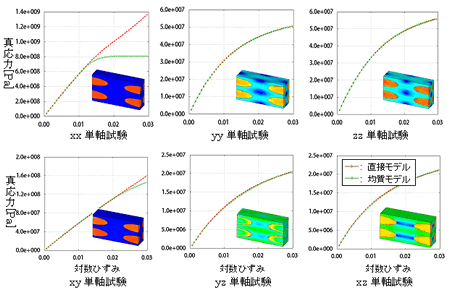
Figure 2: Numerical material test results of the directly model and the homogenized model
Document request
Please contact us.
関連情報
関連する解析事例
MORE
関連する資料ダウンロード
MORE-
【カタログ】3Dデザインソリューション
-

設計者CAEを”使われる仕組み”にするには?
アルパイン設計事務所様に学ぶ、Ansys Discovery 定着の実践事例
-
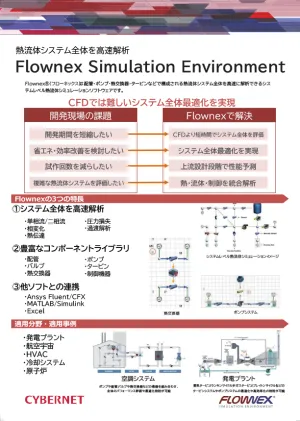
熱流体システム全体を高速解析ーFlownex Simulation Environmentー
-

金型設計から量産までをIoT生産データでつなぐ一気通貫のものづくり
-

実形状ベースのCAEソリューション
~CTデータを活用した高精度シミュレーション~
-
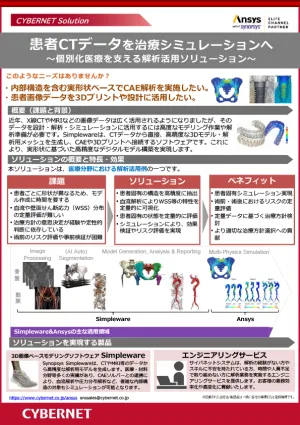
患者CTデータを治療シミュレーションへ
~個別化医療を支える解析活用ソリューション~
-
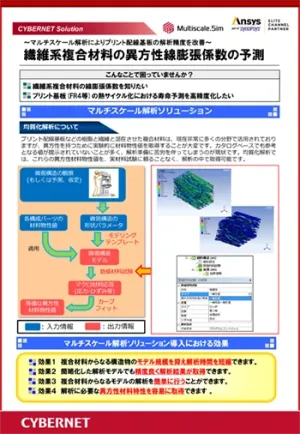
繊維系複合材料の異方性線膨張係数の予測
~マルチスケール解析によりプリント配線基板の解析精度を改善~
-
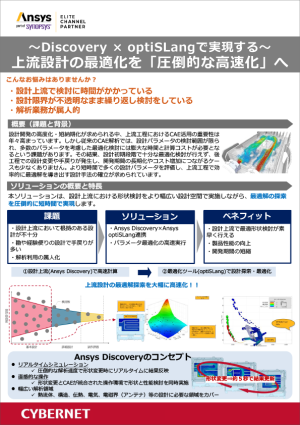
短時間で設計パラメータを評価。上流設計の最適化を「圧倒的な高速化」へ
設計上流における形状検討をより幅広い設計空間で実施